Programme setup & launch
Full network build including tracking integration, commission structure design, cookie policies, T&Cs, and an initial partner recruitment pipeline ready for day one.
We fix underperforming affiliate programmes and launch new ones that contribute 10%+ of online revenue inside six months — at a cost of sale that improves as the channel scales, not the other way round.
Want results like these? Request your free audit today60-second calculator
Plug in your online revenue and current affiliate contribution. We'll show you the gap to the 10–15% benchmark — and what fixing it could be worth in pounds.
Trusted by ambitious ecommerce brands






As an SEO, PPC and affiliate marketing agency, we have built fantastic relationships with B2C and B2B clients thanks to fantastic results and a collaborative delivery method. See what some of our clients say about our affiliate marketing management service.
We're not tied to a single platform, so our recommendations start with your business, not our commercials. We also handle migrations end-to-end when the network you're on is the wrong fit — no in-house lift required.
Awin

CJ Affiliate

Rakuten

Impact

Partnerize
Webgains
Book your free 30-minute audit and we'll show you exactly where the gaps are — whether or not you hire us.
Or call 0191 338 6903
Whether you're launching from scratch or rebuilding a programme that's stalled, the journey to 10–15% of online revenue follows the same playbook from month two onwards. What changes is where we start.
From zero to a programme contributing meaningfully to online revenue. The first 90 days are about building the foundations properly — get them right and the next 12 months compound naturally.
First 90 days — foundations
Full network build including tracking integration, commission structure design, cookie policies, T&Cs, and an initial partner recruitment pipeline ready for day one.
Identifying and onboarding high-value affiliates across content, comparison, cashback and niche category-specific publishers — the partners that move the needle in your sector.
Ongoing — what compounds the channel
Three-tier communication: onboarding new partners, retaining top performers, re-engaging lapsed accounts before they fall off the network.
Every transaction attributed to affiliate is validated — ensuring accurate commission payouts and protecting your cost of sale from over-claimed conversions.
Monitoring your direct competitors' affiliate activity — the partners they're working with, the commissions they're paying, the campaigns they're running — and adjusting your programme accordingly.
Performance dashboards, partner-level insights, and strategic recommendations — delivered as a working document, not a PDF nobody opens.
Father's Day, Black Friday, Boxing Day, January sales — the calendar moments that disproportionately drive annual revenue. Planned and partner-aligned weeks ahead.
Commission tweaks by partner type, voucher suppression rules, attribution adjustments, partner reactivation pushes — the small weekly decisions that separate plateauing programmes from compounding ones.
We start by understanding what your programme is doing today — what's working, what's leaking, what's been quietly missed. From there we rebuild whatever's not delivering, without disrupting what is.
First 90 days — diagnosis & rebuild
A full diagnostic of what your programme is doing today — partner mix, commission leakage, lapsed accounts, tracking integrity, revenue concentration. The strategic foundation everything else gets built on.
Recruiting into the partner types missing from your current mix — adjacent verticals, audiences and channels you should already be in but aren't.
Ongoing — what compounds the channel
Three-tier communication: onboarding new partners, retaining top performers, re-engaging lapsed accounts before they fall off the network.
Every transaction attributed to affiliate is validated — ensuring accurate commission payouts and protecting your cost of sale from over-claimed conversions.
Monitoring your direct competitors' affiliate activity — the partners they're working with, the commissions they're paying, the campaigns they're running — and adjusting your programme accordingly.
Performance dashboards, partner-level insights, and strategic recommendations — delivered as a working document, not a PDF nobody opens.
Father's Day, Black Friday, Boxing Day, January sales — the calendar moments that disproportionately drive annual revenue. Planned and partner-aligned weeks ahead.
Commission tweaks by partner type, voucher suppression rules, attribution adjustments, partner reactivation pushes — the small weekly decisions that separate plateauing programmes from compounding ones.
Partner mix
Programmes that plateau at 3% of revenue rely on one or two partner types. Programmes that compound past 15% run a full-funnel partner mix — six distinct types, each doing a different job at a different stage of the customer journey.
"I didn't know this existed."
"Is this the right one for me?"
"I'm ready, give me the deal."
"Bringing customers back."
High-authority publications. Editorial placements that deliver PR value alongside commission-based traffic — exposure your paid channels can't replicate.
Their job: Discovery and credibility
Vetted nano to macro creators across beauty, home, fashion, baby, fitness and hospitality. Every partnership sits inside your tracking infrastructure — no broken attribution when content goes live.
Their job: Authentic top-of-funnel reach
Gated audiences with strong brand affinity — teachers, NHS, military, parents. High conversion, protected from public discounting, and an underused part of most affiliate mixes.
Their job: Audience reach without brand erosion
High-intent, converting audiences — but easily mismanaged into cannibalising other channels. We structure commission so cashback drives genuinely new revenue, not sales you'd have had anyway.
Their job: Volume and conversion rate
Used carefully, voucher partners drive incremental volume on your terms. Used carelessly, they eat margin. We apply suppression and attribution rules to protect both.
Their job: New-customer acquisition at scale
Comparison Shopping Services and browser-extension partners. Capture users in-market for your products at low CPA — the bottom-of-funnel efficiency play.
Their job: Bottom-of-funnel cost efficiency
Free · No obligation · Instant result
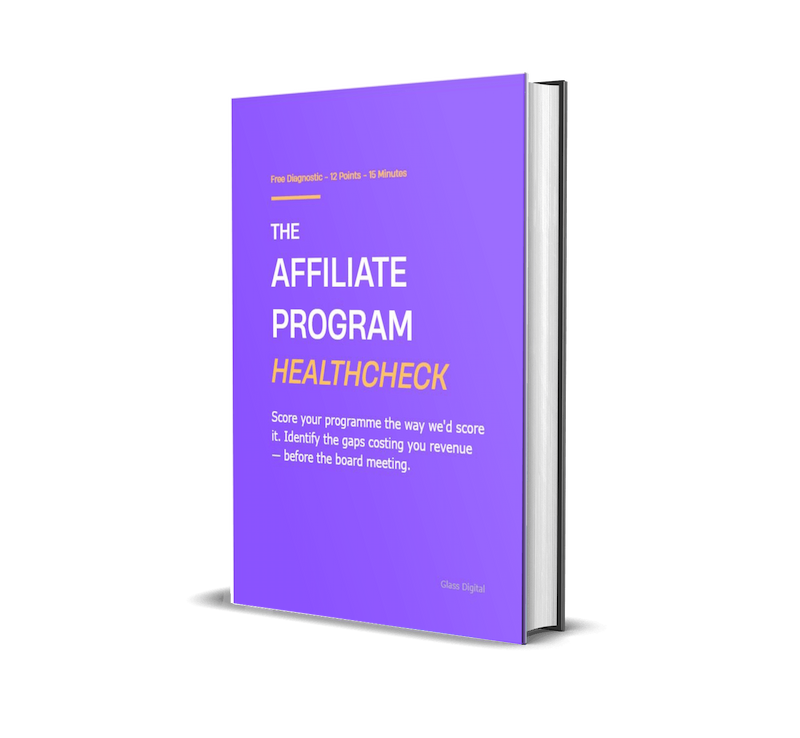
The same 12-point diagnostic we run on every new client's affiliate programme — now interactive. Answer 12 questions, get your score against industry benchmarks, see your priority area, and find out exactly what to fix first.
No signup needed to see your result. We'll only ask for your email if you want the PDF and a copy of your scoring.
Already know what's broken? Skip the diagnostic and book your free audit →
Frequently asked
Honest answers. If yours isn't here, ask us on the discovery call — we won't pretend we have a tidy answer if we don't.
UK affiliate marketing agencies typically charge £1,000–£10,000 per month, depending on programme size and scope. The wide range reflects two real differences: how mature the programme is, and what's included in the remit.
Two things every prospective client should ask before signing with any affiliate agency. First, what's the total cost of running the programme — not just the agency fee, but the network fees, publisher commission payouts, override charges, and any optional spend like tenancy fees for premium placements. Surprises here are how agency relationships go wrong. Second, are agency incentives aligned with yours — are they paid more when the programme grows efficiently, or simply when it grows at any cost?
Glass Digital prices on programme size and scope, transparently quoted against your actual programme. The free audit is the natural place to walk through the full cost picture — fees, network costs, expected commission spend, and where optional spend like tenancies might genuinely earn their keep — so you can compare like-for-like against any other agency you're considering.
This is the most common — and most legitimate — concern about affiliate marketing. The honest answer: cannibalisation happens in badly-managed programmes, and it's exactly the problem proper affiliate campaign management is designed to solve.
Three things prevent it: voucher suppression rules so partners can't claim a sale when the user searched for "brand + voucher" at checkout; commission structures weighted by partner type so cashback isn't paid the same as content publishers driving genuinely new traffic; and incrementality testing to identify which partners drive new customers vs. existing ones. Programmes we audit regularly find 15–30% of paid commission was on cannibalised sales — that's the work.
The bigger answer is that a good affiliate programme isn't just cashback and voucher. It's content publishers, closed user groups (Blue Light Card, KidStart), influencers, comparison sites, CSS partners — partner types that introduce your brand to audiences your paid channels can't reach. CJ Affiliate's incrementality study across 21 million shoppers found affiliate-acquired customers deliver 88% higher revenue per shopper than other channels, which is the opposite of cannibalisation.
For new programmes, the foundations are typically in place within 30–60 days, with measurable revenue within 90 days. Programmes scaling toward the 10–15% revenue-contribution benchmark usually take 6–12 months — that's a generalisation, but it reflects the reality that compound growth comes from sustained partner recruitment, commission optimisation and seasonal campaign timing, not from the initial launch.
For existing programmes that we take over, the timeline is different. Quick wins (commission restructuring, attribution fixes, lapsed partner reactivation) often deliver impact within the first quarter. Structural changes — diversifying into new partner types, migrating networks — are 3–6 month projects with compounding upside.
What we won't do is promise specific results inside specific timeframes for your business sight-unseen. Anyone quoting "X% growth in Y days" without seeing your programme is either guessing or selling. The audit is a more honest way to set expectations.
It depends on your programme's stage and your team's bandwidth. A dedicated in-house affiliate manager typically costs £45,000–£70,000 per year plus tooling and network fees — workable economics if your programme is large enough to justify a full-time hire, harder if you're under £5m online revenue and the role would absorb maybe 30% of someone's time alongside other duties.
An affiliate marketing agency makes sense when you want senior expertise without a full-time hire, when you need access to relationships with networks and partners that take years to build internally, or when the programme needs strategic restructuring rather than steady-state management. The right comparison isn't agency vs in-house cost — it's agency cost vs the revenue uplift from doing the channel properly, which for most ecommerce brands is many multiples of agency fees.
The wrong answer is hybrid in name only — an agency that does the bare minimum while an in-house person also half-manages it. Pick a model and resource it properly.
It depends on your sector, your scale, your tracking sophistication, and which partners are critical to your category. Awin is dominant in the UK with strong publisher coverage; CJ has deeper enterprise tooling and a stronger US partner base; Impact is the technology leader for sophisticated attribution and partnership types beyond traditional affiliate; Rakuten Advertising leans premium retail; Partnerize and Webgains have specific strengths in different verticals.
Glass Digital is platform-agnostic — we run programmes across all six and recommend based on your business, not commercials. We're also experienced at managing migrations end-to-end when the network you're on is the wrong fit, so this question doesn't have to be permanent. The right choice for a £2m fashion brand launching is rarely the right choice for a £30m homeware brand restructuring an existing programme. The audit looks at this specifically.
Daily affiliate program management is less glamorous than agency websites suggest, and that's the point — it's the unglamorous work that compounds. A typical week involves partner recruitment outreach, commission tier optimisation by partner type, validating transactions to protect cost of sale, attribution rule maintenance, lapsed partner re-engagement, weekly performance review against forecast, seasonal campaign planning ahead of trading peaks, and competitive intelligence on what your direct competitors are running.
Strategic work happens monthly and quarterly — performance reviews, partner mix decisions, commission restructures, network reviews, incrementality analysis. Reporting is delivered as a working document used in conversation, not a PDF nobody opens.
The work that doesn't fit on a deliverables list but matters most: relationships with the partners that move revenue. The top performers in your category get pitched constantly. Whether they pick up your call when you need a Black Friday slot is the difference between a good programme and an average one.
It shouldn't, if the transition is run properly. The first 30 days of any agency switch should be diagnostic, not disruptive — understanding what's working before changing what isn't. Existing partner relationships continue uninterrupted, existing commission structures stay in place, and we audit before we touch anything. Changes happen in week 4–8 once we've earned the right to make them.
What we'll usually find is a mix: some things working well that should continue, some quietly leaking margin or cannibalising other channels that need restructuring, and significant gaps in partner coverage that the previous agency didn't fill. The audit is the document we work from — and we share it with you in full whether you hire us or not.
The riskier transition isn't agency-to-agency, it's network-to-network. Where a network migration is genuinely the right call, we project-manage it end-to-end with no in-house lift required.
Affiliate marketing works for ecommerce brands across a wide range — but the economics shift at different stages. Below roughly £500k online revenue, the network fees and management overhead can be hard to justify unless your margins are strong; lighter-touch tools or in-house management often make more sense at this stage.
The sweet spot for agency-managed programmes is £1m–£50m+ online revenue, where the channel can realistically contribute 10–15% of online revenue at a healthy cost of sale, and where the strategic complexity (partner mix, commission structures, attribution) genuinely needs senior expertise to manage. Above £50m, in-house teams become viable, often working with an agency in a specialist capacity rather than full management.
Sector matters too. Affiliate works particularly well in considered-purchase categories where buyers research — home, beauty, fashion, baby, B2B services, specialist retail. It works less well in pure-impulse categories or markets where the purchase decision is dominated by a single distribution channel. The free audit is the cheapest way to find out which side of the line you're on.
Question we didn't cover? Ask us directly on the audit call.
Book your free auditCase studies
Four programmes across beauty, automotive, home and travel. Different sectors, different starting points, the same operational discipline.
31%
of online revenue from affiliate
A multi-territory programme where affiliate isn't a side bet — it's the dominant revenue channel.
3.3×
ROAS uplift in 24 months
A new programme rebuilt for efficiency — channel cost of sale slashed while revenue volume scaled.
+30%
ROAS improvement year-on-year
A programme that compounds year on year — efficiency improving at the same time as revenue scales.

+60%
ROAS recovery year-on-year
A channel pulled back from a soft year — and now performing at its strongest in the programme's history.
Want the detail behind these numbers? We'll walk you through the closest match to your business on the audit call.
Ready when you are
Book a free 30-minute audit. We'll show you exactly where the gaps are in your programme — whether or not you ever hire us.
Or call us directly: 0191 338 6903
Top-performing ecommerce brands see affiliate marketing contribute 10–15% of online revenue. Answer two or three quick questions below to see where you sit — and what the gap is worth.
If you're not sure, ballpark it — you can refine this with us later.
The free audit
A 30-minute discovery call where we actually listen, followed by a tailored audit of your programme and competitor landscape — delivered back to you as a working document you can use regardless of whether you hire us.
No pitch deck, no pre-canned sales flow. We ask questions and build an honest picture of where your programme sits today (or where it could sit if you haven't launched yet). A sample of what we'll cover:
After the call, we do the real work. You receive a written audit covering: