How much of your online revenue should come from affiliate marketing?

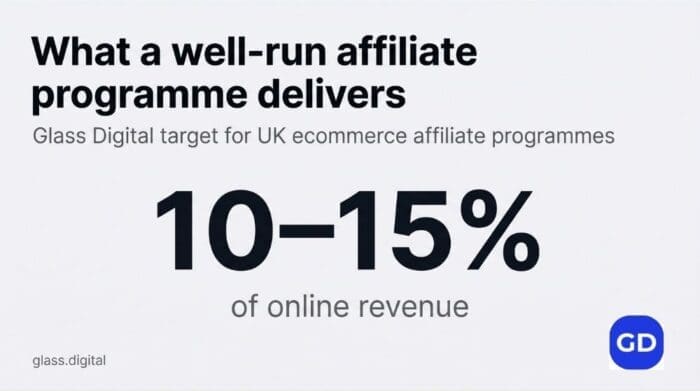
A well-run UK ecommerce affiliate programme should contribute between 10 to15% of online revenue. The market average is 9–10%, which tells you that most programmes are not well run. If you are sitting at 4-7% then you’ve got some work to do.
Key figures
- Glass Digital targets 10–15% of online revenue from affiliate marketing for the ecommerce brands it works with.
- Affiliate marketing generates roughly 9–10% of UK online retail revenue across a full year (Glass Digital calculation from APMA and ONS data, 2025)
- UK brands invested £1.78bn in affiliate / partner marketing in 2025, generating £20.7bn in revenue (APMA, State of the Affiliate Nation 2026)
- £1 in every £7 spent across Cyber Weekend 2025 tracked through an affiliate link. (APMA, State of the Affiliate Nation 2026)
- Shoppers who interacted with affiliates produced 88% more revenue than those who didn’t, across 21 million retail consumers (CJ Affiliate incrementality study, US, 2019)
Last reviewed: 24 August 2026
How much should affiliate marketing contribute to your online revenue?
Glass Digital targets 10–15% of online revenue from affiliate. The market-wide average sits just below that, at around 9–10%, and the gap between the two is the whole argument for running the channel properly rather than leaving it on autopilot.
That market figure comes from the APMA’s 2025 industry data set against ONS retail statistics. Retail accounts for 47% of the APMA’s reported £1.78bn of UK affiliate spend, and applying the APMA’s reported return of £15 for every £1 gives around £12.6bn of tracked retail revenue against ONS internet retail sales of £132.3bn.
The full working, including how the ONS annual figure is derived, is in the notes at the foot of this article.
One caveat before you compare yourself to anything. Affiliate marketing’s share jumps at peak trading. Across Cyber Weekend the APMA puts £1 in every £7 through an affiliate link, against roughly £1 in £10 across the year as a whole.

That is a Black Friday number. Holding your performance to it in mid-February will make a healthy channel look broken.
How much of your affiliate revenue is genuinely new?
More than last-click reporting suggests, and less than all of it. But this is true of every channel you run. There is no such thing as a 100% incremental channel. Paid search takes credit for brand search demand. You pay for customers who were coming back anyway with remarketing. The question is not whether affiliate marketing is incremental, but which partners within your programme create demand and which simply claim it.
The largest study on this remains CJ Affiliate’s analysis of 21 million retail consumers and 5.5 million transactions, which compared shoppers who interacted with affiliates against a matched group who did not. (Controlling for brand awareness, seasonality and time to conversion).

The mechanism is not mysterious. A content or comparison partner reaching someone early in a considered purchase is competing for a decision that has not been made yet. If you are visible in that moment and your competitor is not, some of those sales happen because of the investment. That is demand creation, or a “marketing moment”, and it looks nothing like a browser extension firing on a customer already at your checkout.
The APMA found that close to £1 in every £5 of UK affiliate spend now runs outside pure last-click CPA, in tenancy, hybrid and other models. Brands are paying for influence rather than only for the final click.
What nobody publishes is a reliable figure for how much of any given programme’s revenue is incremental. Yours depends on your individual programme’s partner mix. The practical starting point is to stop treating partner types as interchangeable: a content partner building consideration months before a purchase is not doing the same job as a browser extension firing at the checkout, and paying them the same commission rate is how programmes end up expensive and flat. (If you’re doing this, please stop.)
What decides whether your programme can reach 10–15%?
Four things. A programme at 6% might be badly underperforming or close to its ceiling, depending entirely on where it sits on these.
| Determinant | Supports a higher share | Caps the share |
|---|---|---|
| Consideration length | Considered purchases where people compare (furniture, electronics, homeware). | Impulse and habitual repeat purchase |
| Discount tolerance | Margin that supports commission and promotional activity | Thin margins or a strict no-discount position |
| Partner Mix | Content, comparison, CSS and creator partners generating demand | A programme that is mostly cashback and voucher at the point of conversion |
| Brand Strength | Growing brands acquiring new customers | Established brands where demand mostly arrives direct |
This sets expectations rather than measuring anything. It tells you which band to judge yourself against.
Partner mix moves the number most, and it is the one most programmes barely touch, although increased LLM use (which often uses content partners as sources), has meant more brands are seeking varied partner types. A programme built entirely on cashback and voucher partners reaches a share quickly and then stops, because those partners convert demand rather than create it. The brands clearing 15% have spent time recruiting the partners that are harder to sign.
The upper end is real. The Organic Pharmacy, a Glass Digital client, reached 31% of online revenue from affiliate marketing in 2025, roughly three times the market average.
What is the gap worth?
At 10%, a £5m online business generates £500,000 a year through affiliates. The same business at 5% generates £250,000. That £250,000 is the cost of leaving the programme alone. Ouch.

At £20m online revenue, the same five-point gap is £1m a year. Whether it is closeable depends on the four determinants above, and Glass Digital’s Affiliate Revenue Calculator runs the same sums against your own figures.
When 10–15% is the wrong target for your business
Sometimes the honest answer is that affiliate will never be a major channel for you. Three situations come up repeatedly.
Thin margins on high-frequency purchases. Once commission, network fees and management are stacked up, there may not be enough margin left to attract partners worth having.
A strict no-discount position. Cashback and voucher partners are the largest categories in the UK market by some distance. Ruling them out is a legitimate brand decision, but it removes most of the available volume, and forcing the channel anyway tends to undermine the positioning that made the brand work.
Demand that already arrives direct. Where a brand is strong enough that most customers come straight to the site, affiliate largely intercepts existing intent. Revenue moves between channels and the total does not grow.
In each case 4–5% is close to the ceiling, and the money belongs elsewhere.
FAQ
Is a 5% affiliate share bad? A 5% affiliate share is roughly half the UK market average of 9–10% and a third of what a well-run programme achieves. For a considered-purchase retailer it signals a problem, usually partner mix. For a thin-margin or strict no-discount business it may be close to the realistic ceiling.
How much affiliate revenue is actually incremental? No channel is fully incremental, and affiliate is no exception. CJ Affiliate’s study of 21 million retail consumers found shoppers exposed to affiliate produced 88% more revenue than those who weren’t. What that means for your programme depends on partner mix, which varies enormously between programmes.
Does the 9–10% figure include cashback and voucher partners? Yes. The APMA’s £20.7bn covers all tracked affiliate revenue including cashback, voucher, content, comparison, CSS and creator partners. It measures revenue tracked through affiliate links, not revenue that would have been lost without them.
Does affiliate contribution vary by retail sector? Almost certainly, but no independent UK source publishes affiliate share of online revenue by retail sub-sector. The APMA reports retail as a single vertical at 47% of UK affiliate spend. Any sector-level benchmark you are shown is somebody’s estimate and should be treated as one.
Should marketplace sales count? No. Marketplace revenue sits outside most affiliate programmes and outside the APMA’s tracked figures, so exclude it from both sides. Measure affiliate revenue against your own site’s online revenue, not against total online revenue including Amazon or eBay.
Notes on method
The 9–10% market figure is calculated as follows. The APMA reports UK affiliate and partner marketing spend of £1.78bn in 2025, of which retail accounts for 47%, giving £837m. Applying the APMA’s reported return of £15 for every £1 spent produces around £12.6bn of tracked retail revenue. ONS puts UK internet retail sales at £132.3bn for 2025, giving 9.5%.
| Return assumption | Tracked retail revenue | Share of UK online retail |
|---|---|---|
| 12:1 | £10.0bn | 7.6% |
| 15:1 (APMA figure) | £12.6bn | 9.5% |
| 19:1 (APMA upper) | £15.9bn | 12.0% |
ONS publishes no annual internet sales total, so £132.3bn is derived from twelve monthly average weekly values (Retail Sales Index, series JE2J) across 52 weeks. Applying the same method to all retailing gives £481.9bn for 2025, against the British Retail Consortium’s reported £483bn for the twelve months to September 2025. ONS figures cover Great Britain and exclude automotive fuel and in-store click-and-collect. The APMA publishes retail spend share but not retail revenue, which is why this is a range rather than a single number.
Written by Craig Hall, Operations Director at Glass Digital, a UK SEO, PPC and affiliate marketing agency for ecommerce brands.