Does affiliate marketing help AI visibility? We tested three UK categories

When AI assistants cite editorial content while answering UK ecommerce buying questions, the cited page carries affiliate links 87.7% of the time. But how much editorial an assistant reaches for varies wildly by category. We ran the same 25-prompt structure across three UK retail categories (kitchenware, automotive parts and designer furniture) to find out where the “affiliate marketing to AI visibility” argument holds and where it doesn’t.
Key figures
- 87.7% of editorial pages cited by AI assistants in this small study carry affiliate links. 420 of 479 retrievals to commercially classifiable editorial pages.
- Editorial that contains affiliate links made up 29.6% of all retrieved sources in kitchenware, 7.8% in automotive parts and 10.2% in designer furniture.
- Roughly 1,270 AI answers analysed across ChatGPT, Google AI Overviews and Gemini
- 77% of editorial retrievals in kitchenware went to listicles (“best X” roundups). In furniture it was 79%, in automotive 69%.
- We ran brand prompts within our same and found that the brand’s own website was the single most-retrieved source in all three categories.

Why don’t affiliate links help SEO?
Affiliate links pass no ranking signal, by design. Google’s own documentation instructs publishers to mark paid and affiliate links with rel="sponsored" or rel="nofollow", which signals that Google should not associate the linking page with the destination. SEO teams often pitch products to publishers and receive an affiliate link in return, which has no innate SEO value.
Only 12 months ago this friction made affiliate and SEO teams uneasy colleagues, and this had been the status-quo for two decades. Digital PR chases editorial links that pass equity. Affiliate managers chase placements that drive sales. When the same publisher relationship produced a sponsored link instead of a followed one, the SEO side counted it as a “wasted pitch” – minus the additional exposure for the brand (but that’s not what SEOs are paid for).
Retrieval does not work on link attributes. When an assistant answers a question, it fetches pages and reads them. The rel attribute governs how a search engine treats the link; it has no bearing on whether a language model reads the brand name in the sentence beside it. That is the mechanism the industry has spent 2026 pointing at, and it is why several networks now argue that affiliate content has become an AI visibility asset.
Which sources do AI assistants actually cite for UK buying questions?
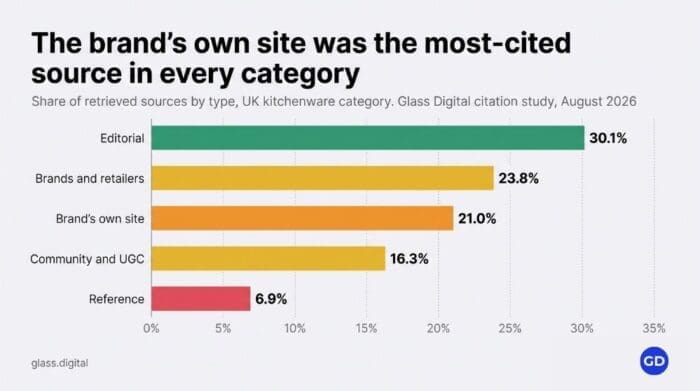
Across the three UK retail categories that we tested, AI assistants drew most heavily on the brand’s own website. Next were community platforms and retailer sites, with editorial content ranging from 5.5% to 30.1% of retrieved sources depending on category. The variation between categories was larger than any other pattern in the study.
We built a 25-prompt set for each of three categories (kitchenware, automotive parts and designer furniture), matched for structure across five intent types: buying decisions, brand comparisons, problem solving, specification and safety and purchase and availability. Each set ran daily across ChatGPT, Google AI Overviews and Gemini from 26 to 28 August 2026, producing roughly 1,270 answers and thousands of source retrievals.
| Source type | Kitchenware | Automotive parts | Designer furniture |
|---|---|---|---|
| Editorial | 30.1% | 5.5% | 9.3% |
| Corporate (brands and retailers) | 23.8% | 30.1% | 33.1% |
| Brand’s own site | 21.0% | 15.0% | 23.8% |
| Community and UGC | 16.3% | 32.1% | 20.6% |
| Reference | 6.9% | 5.1% | 4.4% |
| Institutional | 1.3% | 6.8% | 7.7% |
Glass Digital citation study, 26–28 August 2026. Shares calculated on the 60 most-retrieved domains per category, which carry the large majority of retrievals. Classification is Peec AI’s, with adjustments noted below.
The results were interesting to say the least, and 2 results are worth pausing for. The first is that in automotive parts. Community content (Trustpilot, Reddit, YouTube, owner forums etc.) accounted for 32.1% of retrievals, and Trustpilot alone was retrieved more often than the retailer’s own website. The second is that the brand’s own domain was the most-retrieved single source in every category, which sits awkwardly beside the fashionable claim that owned content no longer matters.
How often is the editorial content AI cites affiliate-monetised?
Very often, and consistently across categories. We checked all 66 editorial and reference pages cited in the study and found that 87.7% of editorial retrievals went to pages carrying affiliate links (mainly SkimLinks, Awin and Amazon). The rate was 93.1% in kitchenware, 87.4% in designer furniture and 75.9% in automotive parts. So if you don’t have an affiliate program but you are trying to get featured in editorial, you’re swimming upstream.

Page type explains why. Of editorial retrievals, 77% in kitchenware, 79% in furniture and 69% in automotive went to listicles, so articles like “best air fryer”, “best all-season tyres”, “best online furniture stores” etc.. Add comparison pages and the figure exceeds 80% in every category. Roundups are the format assistants reach for when they step outside brand and retailer sites, and roundups are overwhelmingly how publishers monetise commercial search traffic.

This is the finding that makes the industry’s argument credible. It is also narrower than the industry’s argument, because it says nothing about how much of any given category’s answer space editorial occupies.
Why does the opportunity differ so much between categories?
The publishing ecosystems differ, not because the mechanism differs. In our study, affiliate-monetised editorial accounted for 29.6% of all retrieved sources in kitchenware but only 7.8% in automotive parts, a near four-fold gap produced by identically structured prompt sets running over the same three days.

Kitchenware has a dense, permanently refreshed roundup economy: BBC Good Food, Expert Reviews, IndyBest, Ideal Home, Telegraph Recommended, Good Housekeeping, The English Home and T3. A brand with an active content partner programme has dozens of doors.
Automotive parts has almost none. The editorial that assistants did cite was motoring press rather than shopping content, and three of the largest titles in the set, Auto Express, Car Magazine and Parkers, carried no affiliate links at all, which is why automotive’s monetisation rate is the lowest of the three. One page, The Car Expert’s roundup of car parts websites, drew 37 retrievals and 50 citations, making it the most-cited third-party page in the entire study. For a car parts retailer, that is not a channel strategy. It is a single door.
Designer furniture sits between the two, and behaves differently again: the three most-cited third-party pages were all “best online furniture stores” roundups. In that category assistants recommend retailers rather than products, which points at brand-level placement rather than product seeding.
Glass Digital’s reading is that three distinct profiles emerge:
| Profile | What dominates | Where to spend first |
|---|---|---|
| Editorial-led kitchenware here |
Roundup and review publishers | Content-partner recruitment and product seeding |
| Community-led automotive parts here |
Trustpilot, Reddit, forums, YouTube | Review volume, community presence, the few roundups that exist |
| Retailer-led designer furniture here |
Stockists and marketplaces | Retailer listings, stockist relationships, brand-level roundups |
These are observed profiles from one study, not a taxonomy of all retail. The point is that they differ enough that acting on a general rule would misdirect budget.
How do I test my own category? The Glass Digital citation mix test
The test we ran is a repeatable method for measuring how much of your category’s AI answer space is available through affiliate partnerships.
- Build 25 prompts across five intent types: buying decision, brand comparison, problem solving, specification and safety, and purchase and availability. Weight them roughly two to one unbranded over branded, and phrase them as questions a person would type, not as keyword strings.
- Run them daily across the assistants your customers use, for at least a week where possible. Record every cited source.
- Classify each source as brand-owned, retailer, community, editorial, or reference.
- Check the editorial pages by hand for affiliate links. Domain-level classification will not tell you this, and tool classifications disagree with reality often enough to matter.
- Read the profile. If affiliate-monetised editorial is a large share, partner recruitment is your highest-leverage route. If community dominates, review volume and forum presence matter more. If retailers dominate, distribution is the lever.
The number that comes out is not a score. It is a budget allocation input. Steps 1 to 3 are made easy with a tool such as Peec.ai (yes this an affiliate link!), we used Peec to track all of the data for this study.
Which affiliate partner types generate retrievable mentions?
Partner types differ in whether they produce content an AI assistant can retrieve at all. The partner visibility grid below scores partner types on that axis, deliberately using the same taxonomy as the partner incrementality grid so the two can be read together.
| Partner type | Produces retrievable mentions? | Notes |
|---|---|---|
| Content and review publishers | High | The roundups and reviews that made up the large majority of cited editorial in this study |
| Niche and specialist blogs | Medium to high | Appeared throughout the long tail; cheap to recruit, low individual weight |
| Creators and influencers | Medium | YouTube was heavily retrieved in every category; discoverability depends on the platform, not the programme |
| Comparison and aggregator sites | Low to medium | Retrieved, but rarely carrying brand-level commentary |
| Cashback | Very low | Generates transactions and effectively no retrievable content |
| Voucher and discount codes | Very low | Same, and the pages that do get retrieved carry no product commentary |
A programme optimised for last-click conversions will have recruited heavily in the bottom two rows, which is where the immediate revenue is and where the retrievable mentions are not.
Where affiliate and SEO are still in conflict
The convergence is partial. The publisher page that gets a brand cited in ChatGPT is frequently the same page outranking that brand’s own category page in Google for “best X”. The publisher is an ally in retrieval and a competitor in classic search at the same time.
That being said, it doesn’t make much sense generating “best X” if you can’t be genuinely honest about the results. Many retailers also have to weigh up the value of this content vs. their relationships with the brands they stock.
Two further constraints came directly out of the data. Which? was the second most-retrieved domain in kitchenware and drew 63 retrievals across the study, and it is subscription-funded. There is no affiliate route into it; a brand earns its place by making a product that tests well. And in automotive, the largest motoring titles carried no affiliate links either. A meaningful share of the highest-value citation source simply cannot be bought.
What this study can’t tell you
The study measures which sources assistants retrieve and cite. It does not establish that having an affiliate programme causes a brand to be named in an answer, and we’re not claiming it does. The defensible reading is that the pages assistants cite for buying questions are overwhelmingly affiliate-monetised, and that an affiliate programme is the commercial mechanism that gets a brand considered for them.
FAQ
Do affiliate links help SEO? No. Google’s documentation requires affiliate links to carry rel="sponsored" or rel="nofollow", which tells Google not to associate the linking page with the destination. They pass no ranking signal. What they sit beside — a brand mention in editorial content — is a separate matter, and that is what AI assistants read.
Does an affiliate programme improve AI visibility? It plausibly helps in categories where affiliate-monetised editorial makes up a large share of what assistants cite. Glass Digital measured that share at 29.6% in kitchenware and 7.8% in automotive parts. The mechanism is consistent; the size of the opportunity is not. Test your own category before committing budget (or ask us to do that for you).
Which affiliate partners actually generate AI visibility? Content and review publishers, niche blogs and creators produce retrievable content. Cashback and voucher partners produce almost none. A programme recruited purely on conversion history will be weighted towards the partners that generate the least retrievable content, which is the recruitment problem worth fixing first.
Do AI assistants cite the same pages that rank in Google? Often not. Ahrefs’ analysis of 15,000 long-tail queries, published in May 2026, found roughly 11% overlap between AI citations and the Google top 10, with about 80% of AI citations pointing to pages that did not rank for the original query. Ranking and citation have partly decoupled.
Should we still invest in our own website content? Yes. In all three categories Glass Digital tested, the brand’s own domain was the single most-retrieved source. Owned content remains the largest component of what assistants read about a brand, which makes clear product information, specifications and FAQ content a prerequisite rather than an afterthought.
Written by Marc Swann, Director of Search at Glass Digital